- Your cart is empty
- Continue Shopping

F5 vs MGP10: What’s the Difference?
-
 By
Timber Central
By
Timber Central - Posted on
- MGP10

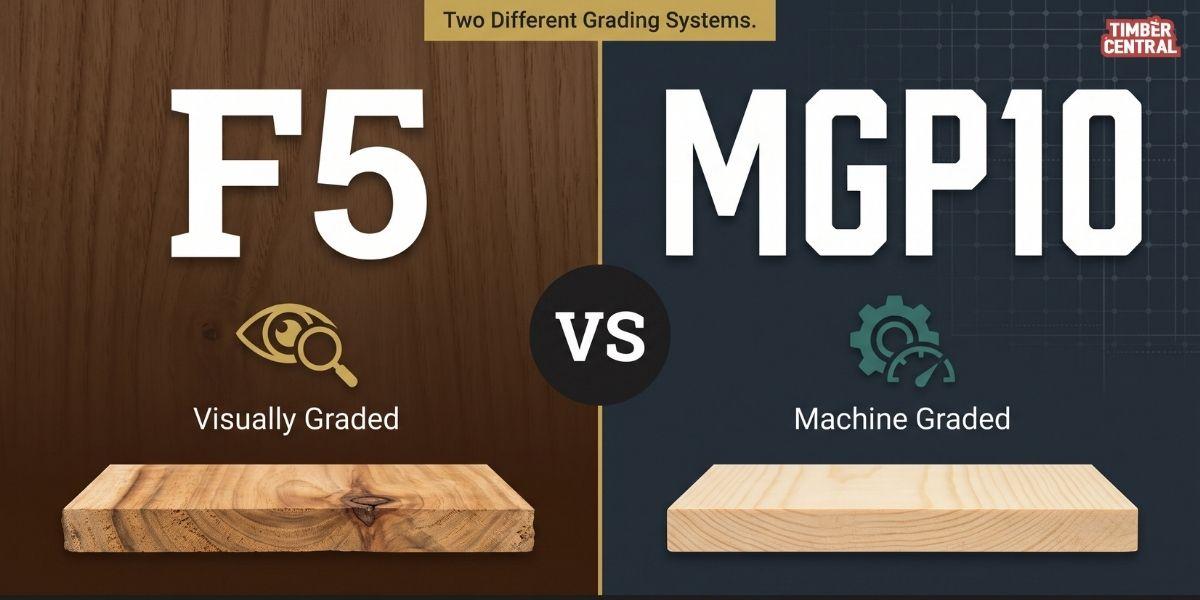
Table of contents
Choosing structural timber can feel straightforward until terms like F5 and MGP10 start appearing on plans, supplier quotes, and engineering specifications. The grades sound similar, but they are not measuring the same thing.
The F5 vs MGP10 discussion is one of the most common questions in the Australian timber industry. Yet the comparison is often misunderstood because these grades come from two different timber grading systems.
Understanding what each grade means, how they are assessed, and where they are commonly used can help avoid costly assumptions later on.
Understanding F5 Timber
A common question is: What exactly does F5 timber mean?
The term “F5” refers to a stress grade used primarily for hardwood and some visually graded structural timbers. The “F” stands for stress grade, while the number represents the timber’s characteristic bending strength.
In simple terms, F5 timber has been assessed and classified according to Australian structural grading standards. The grading process generally relies on visual inspection, where trained graders assess characteristics such as knots, grain patterns, slope of grain, and other natural features that may affect structural performance.
F5 treated pine is also available in the Australian market and is commonly used where treated structural timber is required. However, the grading method remains different from machine-graded pine products such as MGP10.
What Does MGP10 Mean?
MGP10 stands for Machine-Graded Pine with a strength rating of 10.
Unlike F5 timber, MGP10 timber is graded using specialised testing equipment rather than relying solely on visual assessment. The machinery measures stiffness and other performance characteristics, allowing each piece of timber to be assigned a grade based on tested structural properties.
But many people compare the number “5” in F5 and the number “10” in MGP10 and assume MGP10 must automatically be twice as strong. While this sounds logical, it is not.
The two grading systems measure timber differently and cannot be directly compared by looking at the numbers alone.
Hardwood Grading vs Machine Grading Explained
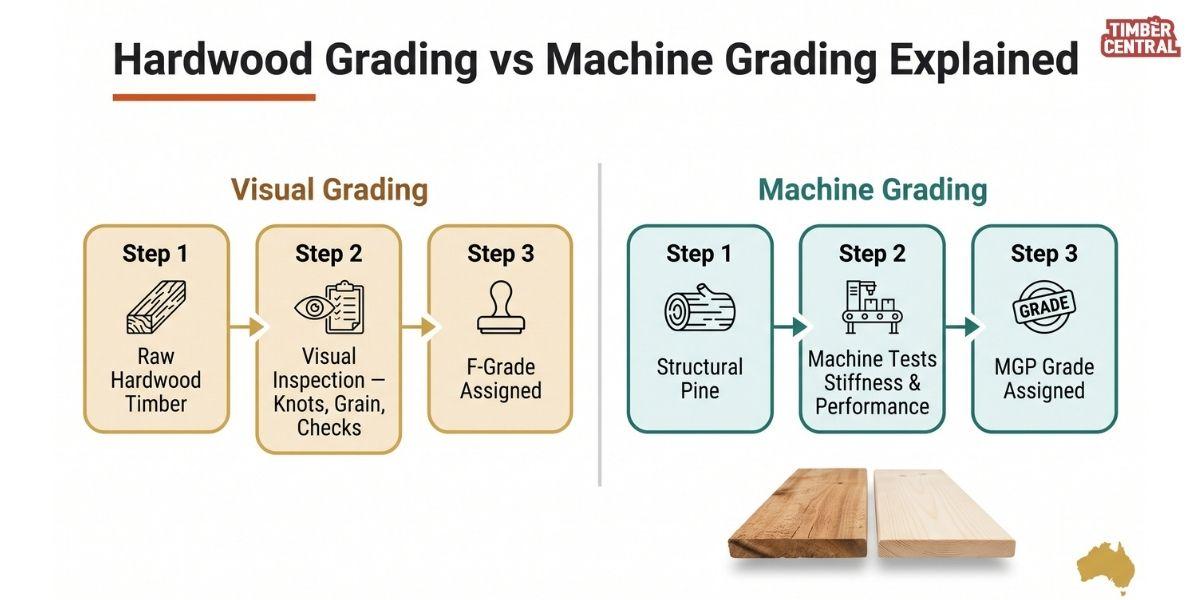
To understand the difference between F5 timber vs MGP10, it helps to understand how each system works.
F-Grading System
F-grades are commonly associated with hardwood timbers and visually graded structural products.
The grading process evaluates natural timber characteristics that may influence strength. Factors such as knot size, grain direction, checks, and other visible features are assessed against Australian grading rules.
Because timber is a natural material, no two pieces are identical. Visual grading aims to account for those variations.
MGP Grading System
MGP grades are generally used for structural pine products.
Machine grading involves testing each piece with specialised equipment to measure stiffness and performance. The timber is then assigned a grade such as MGP10, MGP12, or higher, depending on the measured properties.
This system provides consistency across large production volumes, which is one reason MGP timber is widely used throughout Australia’s building industry.
Comparing Strength and Structural Performance
One of the most common questions involves strength.
The reality is that direct timber grading comparison between F5 and MGP10 is not always straightforward because the grades are derived from different systems.
In general terms, MGP10 timber is engineered to meet specific machine-tested performance criteria. F5 timber is assigned a stress grade through visual assessment methods.
Structural performance depends on more than a single grade number. Species, moisture content, treatment, span requirements, engineering specifications, and design loads all play a role.
Many people focus exclusively on the grade stamp. Experienced builders know the specification matters far more.
This is why structural timber grades in Australia are selected according to engineering requirements, building codes, and project-specific documentation rather than personal preference.
Where Are These Timbers Commonly Used?
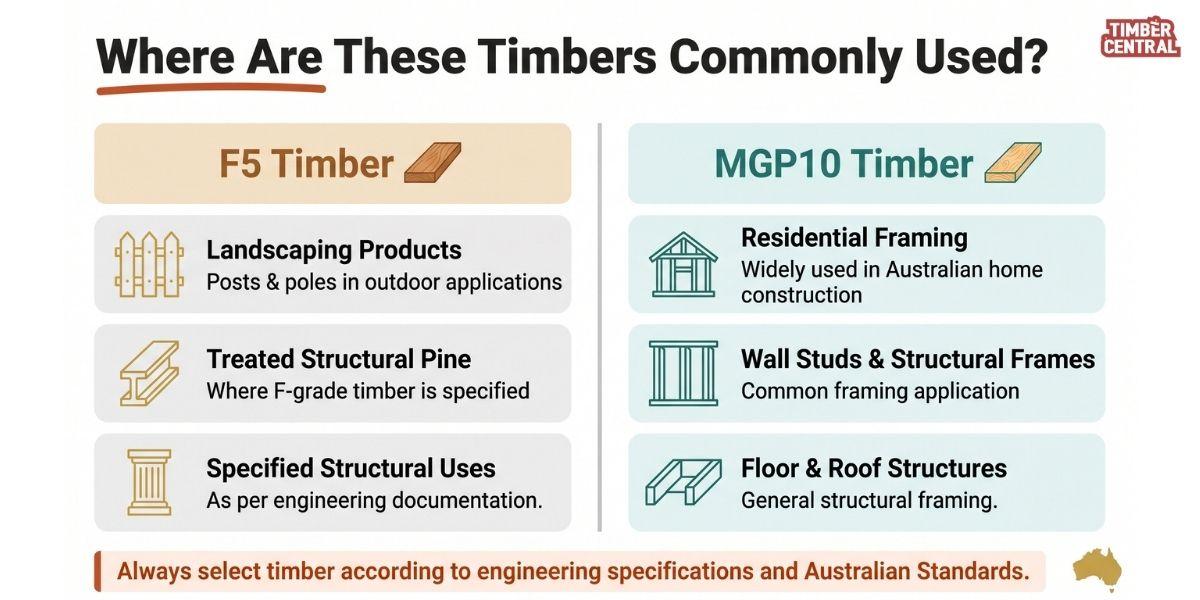
Both F5 and MGP10 are structural timber grades, but they are often found in different product categories.
F5 timber is commonly available in treated pine applications, landscaping products, and various structural uses where F-grade timber has been specified.
MGP10 is widely supplied for residential construction and general structural framing applications across Australia.
However, there is an important compliance point.
The choice between F5 timber and MGP10 should always follow engineering designs, Australian Standards, and relevant building authority requirements. Timber selection is determined by approved specifications, not by substituting one grade simply because it appears stronger or cheaper.
In practice, this is rarely handled correctly by inexperienced buyers.
Substituting structural timber without approval can create compliance issues and potentially affect certification.
Cost and Availability Considerations
Cost is often part of the conversation.
Generally speaking, MGP10 pine products are widely available through Australian timber suppliers because machine-graded pine is extensively used throughout the residential construction sector.
F5 timber products are also readily available, particularly in treated pine ranges and structural timber applications.
Pricing varies depending on dimensions, treatment levels, supply conditions, location, and market demand. There is no universal rule that one grade will always cost more than the other.
How Should Builders Approach the Decision?
The most practical approach is surprisingly simple.
Start with the approved engineering documentation and project specifications. Those documents determine the required timber grade, span capability, and structural performance expectations.
The requirement or choice of timber should always align with Australian Standards, engineering designs, and relevant authority guidelines.
At Timber Central, questions about F5 timber vs MGP10 often arise during project planning. The key consideration is not which grade is “better.” The real question is whether the selected timber meets the specified structural requirements for the project.
That is what matters.
Choose according to compliance requirements. Verify specifications carefully. Avoid assumptions based on grade numbers alone.
FAQs
Is F5 stronger than MGP10?
Not necessarily. F5 and MGP10 belong to different grading systems, so the numbers cannot be directly compared. Structural performance depends on the specific timber product, species, and engineering requirements.
What is the difference between F-grades and MGP grades?
F-grades are generally assigned through visual grading methods, while MGP grades are assigned using machine testing. The systems measure structural properties differently.
When should builders use F5 timber?
F5 timber should be used when specified by engineering documentation, project requirements, or relevant building standards. Timber selection should always follow approved plans and regulations.
Is MGP10 suitable for structural framing?
Yes. MGP10 is commonly used in structural framing applications throughout Australia when it meets the requirements of the project design and engineering specifications.