- Your cart is empty
- Continue Shopping

How Long Does Treated Pine Last? A Builder’s Guide
-
 By
Timber Central
By
Timber Central - Posted on
- Treated Pine

Table of contents
Treated pine remains one of the most widely used timbers across Australian construction projects. It is regularly used for decking frames, pergolas, fencing, landscaping structures, and many other outdoor construction projects. The material appears everywhere for good reason.
Yet one question continues to come up on job sites and during project planning:
How long does treated pine last?
The answer is not as straightforward as many people expect. Treatment helps protect timber against termites, fungal decay, and moisture-related deterioration, but treatment level, installation quality, exposure conditions, and ongoing maintenance all influence the outcome.
Many people assume treated pine is maintenance-free. And that assumption is where a lot of disappointment starts.
Understanding the Real Lifespan of Treated Pine
The typical treated pine lifespan can range from 15 years to several decades, depending on where and how the timber is used.
Properly treated and correctly installed outdoor pine commonly lasts between 15 and 25 years in exposed conditions. Higher treatment levels used in demanding environments can last considerably longer when maintained appropriately. Some manufacturers even provide warranties extending up to 50 years for certain applications and treatment classes. However, warranties and real-world performance are not always the same thing.
When asked, “How long does treated pine last?”, the first response should always be another question:
Which treatment level is being used, and where will the timber be installed?
Without those details, any lifespan estimate is little more than guesswork.
Why Treatment Level Matters So Much
Not all treated pine receives the same level of protection. In Australia, preservative-treated timber is classified according to hazard levels, commonly referred to as H levels. Each level is designed for different exposure conditions.
H1 and H2: Internal Applications
These treatment levels are intended for indoor use where timber remains protected from weather exposure.
The focus is primarily on protection from insect attack, including termites in certain situations. They are not intended for outdoor environments.
H3: Above-Ground External Use
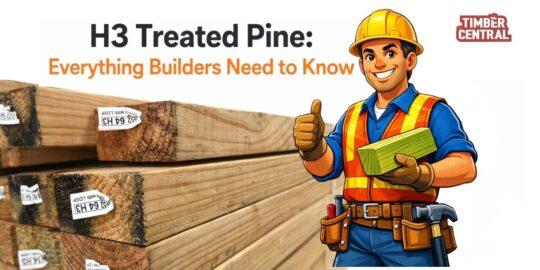
H3 treated pine is designed for outdoor applications above ground where periodic wetting occurs.
Common examples include:
- Deck framing
- Pergolas
- Cladding
- Fascias
- Outdoor structural framing
This treatment level provides protection against moderate decay, termites, and borers when used in the appropriate environment.
H4 and Above: Ground Contact and Higher-Risk Environments
H4 treated pine is intended for applications involving ground contact or severe exposure conditions.
Typical uses include:
- Fence posts
- Landscaping timbers
- Pergola posts
- Garden structures
Higher hazard levels, such as H5 and H6, provide additional protection for more demanding environments.
What Actually Determines Treated Pine Durability?
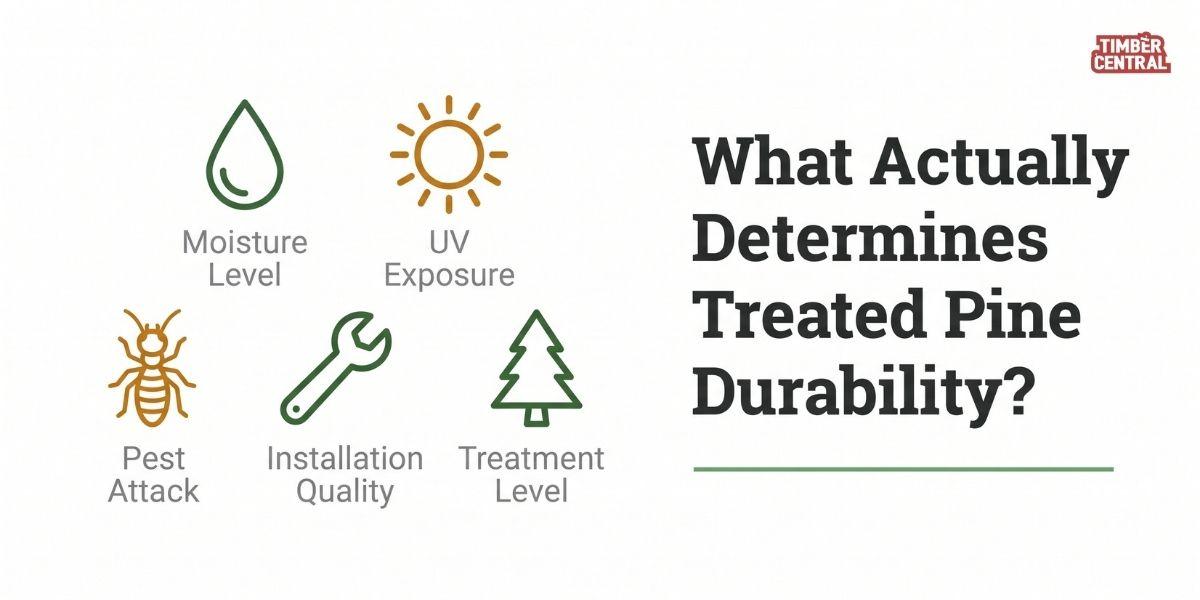
Builders often focus heavily on treatment levels. While they matter, treatment alone does not determine treated pine durability.
Several other factors play a major role.
Moisture Exposure
Timber lasts longer when it can dry effectively between wet periods.
Structures that remain damp for extended periods face a much greater risk of decay, even when treated. Poor drainage, trapped moisture, and inadequate ventilation regularly contribute to premature timber failure.
Installation Quality
Even quality-treated pine can underperform if installation details are neglected.
Common issues include:
- Poor drainage around posts
- Inadequate ground clearance
- Untreated cut ends
- Water-trapping joints
- Insufficient ventilation beneath structures
The timber specification may be correct, but water becomes the real problem.
Local Environmental Conditions
Australia presents some harsh conditions for outdoor timber.
Intense UV exposure, coastal salt air, high humidity, prolonged rainfall, and termite activity all influence the outdoor treated pine lifespan.
A sheltered pergola in Melbourne may experience very different ageing patterns compared with a structure exposed to tropical humidity or coastal conditions.
Indoor vs Outdoor Performance
One of the most common misconceptions is that treated pine performs the same way everywhere. Here is the reality check.
When used indoors and protected from moisture, treated pine can remain serviceable for many decades. The exposure risks are simply lower.
Outdoor applications face a completely different set of challenges. Sun, rain, moisture cycling, fungal attack, and insect pressure place continuous demands on the timber. That is why outdoor service life depends heavily on treatment level and maintenance.
When considering how long treated pine will last outdoors, environmental exposure becomes just as important as the treatment itself.
The Biggest Mistake Builders and Owners Make
The biggest mistake seen repeatedly is assuming treatment removes the need for maintenance.
It doesn’t.
Treated pine is designed to resist decay and biological attack. It is not designed to be ignored indefinitely.
Many timber failures can be traced back to simple maintenance issues that were never addressed.
Examples include:
- Damaged coatings left unrepaired
- Blocked drainage areas
- Persistent moisture buildup
- Untreated cuts and penetrations
- Poor ventilation around structures
The timber may still be treated. The protection system around it has failed.
Extending the Life of Treated Pine
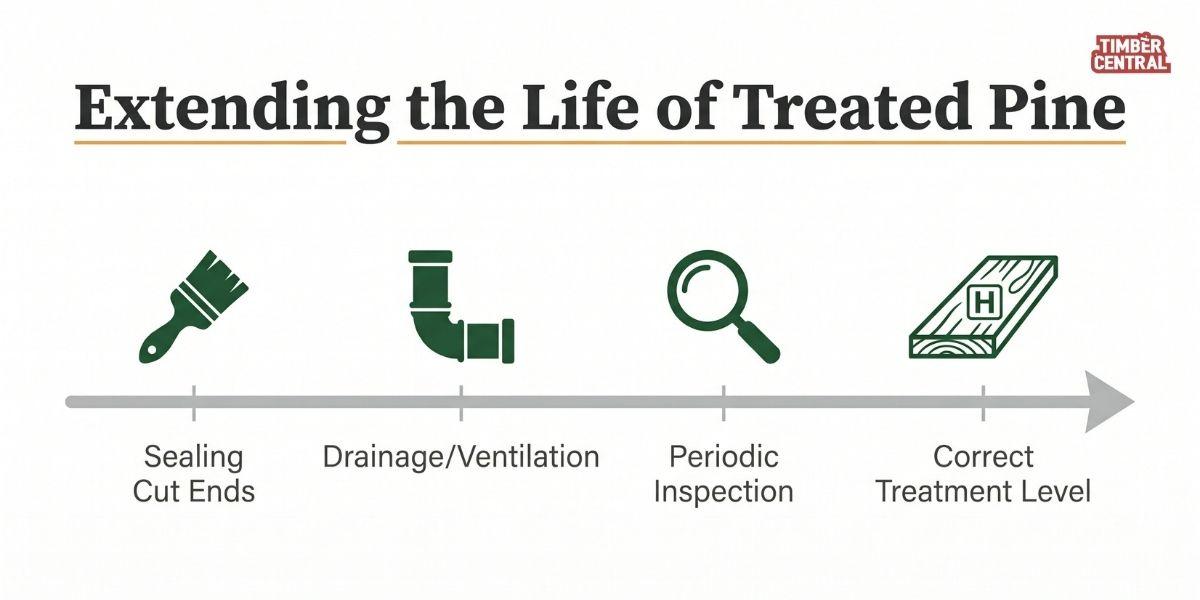
The good news is that achieving a long-treated pine lifespan is usually less complicated than many people think.
Several practical steps can significantly improve performance.
Match the Treatment Level to the Intended Exposure
Treatment levels exist for a reason. Timber should always be specified according to the exposure conditions, project requirements, and applicable building regulations and standards.
Protect Exposed Cut Ends
Whenever treated pine is cut, drilled, or notched, the exposed timber should be resealed using an approved preservative treatment.
Improve Drainage and Ventilation
Good design decisions frequently add years to timber life. Allow water to drain effectively. Avoid moisture traps. Ensure air can circulate around structural elements wherever practical.
Carry Out Periodic Inspections
Regular inspections help identify problems before significant deterioration occurs. Small issues are generally easier and less expensive to address than major structural repairs.
What Builders Should Take Away
When evaluating how long treated pine lasts, there is no single number that applies to every project.
The reality is more nuanced.
Correctly specified, properly installed, and reasonably maintained, treated pine can provide decades of reliable service. Poor detailing, unsuitable treatment levels, and unmanaged moisture can dramatically shorten that lifespan.
Experience across the industry continues to show the same pattern. Projects that perform best are rarely the ones with the most expensive materials. They are the ones where exposure conditions, treatment levels, installation details, and maintenance have all been considered together.
That is what drives long-term durability.
For builders, contractors, owner-builders, and homeowners planning outdoor projects, understanding those factors is far more valuable than chasing a single lifespan figure.
At Timber Central, supplying quality timber is only part of the equation. Helping customers understand how timber performs in real-world conditions is equally important.
FAQs
How long does treated pine last outdoors?
In many outdoor applications, treated pine can last between 15 and 25 years or longer, depending on the treatment level, environmental conditions, installation quality, and maintenance practices. Higher treatment levels used in more demanding environments may achieve significantly longer service lives.
Does treated pine rot over time?
Yes. Treated pine is designed to resist decay, but it can still deteriorate over time if exposed to excessive moisture, poor drainage, inadequate ventilation, or unsuitable installation conditions.
Can treated pine last for decades?
Yes. Properly specified and maintained treated pine can remain serviceable for several decades. The treatment level, exposure conditions, and maintenance regime all influence long-term performance.
How do builders extend the life of treated pine?
Builders typically improve longevity by using the appropriate treatment level for the intended exposure, sealing cut ends, promoting drainage and ventilation, reducing moisture retention, and conducting periodic inspections to identify issues early.