- Your cart is empty
- Continue Shopping

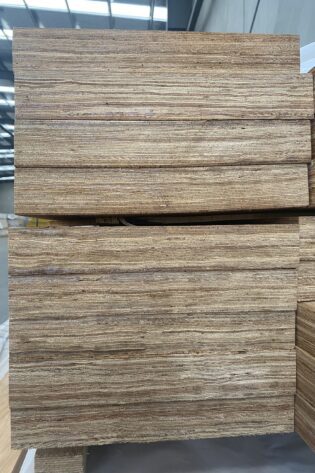
Benefits of Using Timber in Construction: What Actually Matters on Site
-
 By
Timber Central
By
Timber Central - Posted on
- Timber Construction

Table of contents
- Why do so many builders still rely on timber?
- Is timber actually strong enough for structural use?
- Does timber really make construction faster?
- How flexible is timber for design?
- Is timber really a sustainable choice?
- What about durability and long-term performance?
- Does timber actually save money?
- What role does appearance play in choosing timber?
- The key takeaway
- FAQs
- Is timber suitable for large-scale construction?
- Does timber require more maintenance than other materials?
- Can timber be used in modern architectural designs?
- Is timber always the cheapest option?
Timber gets recommended early in a project. Sometimes too early.
It’s often treated as the obvious choice because it is familiar, widely available, and relatively straightforward to work with. But that’s where assumptions creep in. Because while timber does offer clear advantages, those benefits only show up when it’s specified, handled, and installed correctly.
This is where things start to separate.
While timber looks simple, in reality, it isn’t. Decisions around strength, compliance, durability, and sourcing all sit beneath the surface. If you miss those, the benefits disappear quickly.
So the real question isn’t “Is timber good?” That’s already been answered.
The better question is this: where does timber actually deliver value, and where do people get it wrong?
Why do so many builders still rely on timber?
Because it works and that too consistently.
Timber offers a balance that’s hard to beat. Its strength, workability, cost, and performance all sit in a fairly tight range. No material does everything perfectly. But timber comes close enough for most structural applications.
On top of that, it solves more problems than it creates and that matters so much on a job site.
Is timber actually strong enough for structural use?
Short answer: yes.
Long answer: It depends on how it’s specified and used.
Structural timber has an impressive strength-to-weight ratio. That’s not marketing language. It’s a practical advantage. It carries significant loads without the dead weight that comes with steel or concrete.
But strength on paper means nothing if grading and compliance are ignored.
This is where most people get caught out.
Timber must meet the required standards and be selected in line with building codes and engineering specifications. That decision doesn’t sit with preference. It sits with regulation.
Engineered products like LVL push this further. More consistency. Better load performance. Fewer surprises.
When handled correctly, timber performs. When it’s not, problems show up later. Usually when it’s expensive to fix.
Does timber really make construction faster?
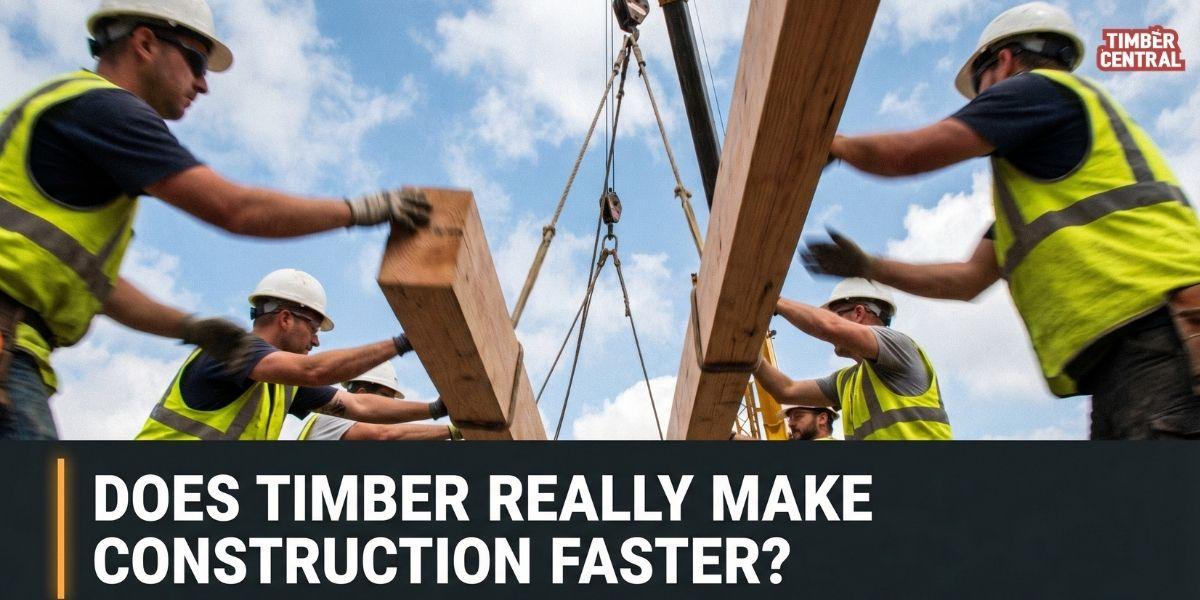
Yes. But not automatically.
Timber is lighter. Easier to move. Easier to cut. That reduces handling time and labour intensity. On many sites, it removes the need for heavy lifting equipment entirely.
That said, speed gains depend on planning.
Timber framing looks quick but poor coordination slows everything down.
When properly managed, timber helps projects move faster. When not, it just shifts the delays elsewhere.
How flexible is timber for design?
Timber adapts easily to different layouts like open spans, detailed features, and unconventional shapes. It can be cut, shaped, and adjusted on site without major disruption.
Architects value that flexibility. Builders rely on it.
But there’s a misconception worth addressing. Flexibility doesn’t mean anything goes.
Design still needs to align with engineering limits and compliance requirements. Timber allows creative freedom, but within boundaries set by standards and approvals.
Is timber really a sustainable choice?
In most cases, yes. But only when sourced responsibly.
Timber is renewable. Trees regrow. Supply cycles continue. Compared to steel or concrete, the energy required to produce timber products is significantly lower.
That reduces overall carbon impact.
But, sustainability depends on certification and supply chain integrity. Not all timber is equal in this regard.
Many assume “timber = eco-friendly.” It usually is, but not automatically.
What about durability and long-term performance?
Timber lasts and performs for decades under structural loads when Properly treated and installed, it performs for.
The biggest mistake seen? Assuming timber is maintenance-free.
Moisture control, treatment, and correct installation all play a role. When those are handled properly, durability isn’t an issue. When they’re ignored, deterioration follows.
Does timber actually save money?
Generally, yes. But not for the reasons most expect.
Material cost is only one part of the equation. Timber is often more affordable upfront compared to steel or concrete. That’s true.
The real savings come from handling and installation as it requires less labour, less equipment and faster build times.
That said, poor planning wipes out those savings quickly.
Timber looks cost-effective, but execution determines whether it stays that way.
What role does appearance play in choosing timber?
More than people admit.
Timber brings natural texture, warmth, and visual character that other materials struggle to replicate. Over time, it develops a patina. That ageing process often improves its appearance rather than degrading it.
This isn’t just aesthetic preference. It affects perceived value.
Spaces built with timber tend to feel different; they feel warmer and more natural.
That said, appearance should never override compliance or structural requirements. It complements the decision. It doesn’t drive it.
The key takeaway
Timber is not a shortcut.
It’s a highly effective material when used correctly, specified properly, and installed with care. But it relies heavily on doing the basics right.
This is the biggest mistake seen across projects: treating timber as forgiving. But in reality, It isn’t.
At Timber Central, supply decisions are aligned strictly with Australian standards and regulatory requirements. The selection of timber is not based on preference. It is guided by compliance, engineering, and suitability for purpose.
Anything else introduces risk. And that risk shows up later.
FAQs
Is timber suitable for large-scale construction?
Yes, especially with engineered timber products. However, suitability depends entirely on design specifications and regulatory approvals.
Does timber require more maintenance than other materials?
Not necessarily more, but it does require proper treatment and moisture management. Neglect is what causes issues.
Can timber be used in modern architectural designs?
Absolutely. Its flexibility makes it suitable for both traditional and contemporary structures.
Is timber always the cheapest option?
Often cost-effective, but not guaranteed. Project planning and execution determine the final cost outcome.